A fevered devotion, in three parts.
I. Egona
I yearn for your sinuous hips in a resinous mist,
An iridescent detonation sparked by your lips.
Your silken form lies ember-tempered beneath my tongue.
Those throat-born murmurs — dense with thirst — as your palm drapes my mounting swell. My touch sways within your velvet flush. When you beg, I bite — our pupils swallowing light, and our rivers flood the weave.
So tell me, my love, why must you leave without an ounce of regard for my pride? Leaving me adrift, ravaged in the abyssal tide.
I don’t believe I’ve ever known love — Only fevered devotion — Until your spirit seared through my ill-lit despair, its glow coursing through my veins.
We’ve waltzed through highs, Clung through the bellowing lows, Where the only certainty was the flicker of our sundered beat.
Can you not taste the ache raking in me? Together, we could claw through the remnants — boundless, we’d flee. But I suppose I’m asking too much.
You’ll never stay. Soon, I see — Though our tremor rattles heaven’s key, It splinters silently — Unthreading who I swore you’d be.
II. Our Fevered Sanctum
I lurk amongst the masses as flesh bred from the ugliness of truth. What’s real isn’t always holy, and what’s holy doesn’t mean it’s right. What the fuck is life but an aimless ride through peculiarity from which none of us can hide? I find clichés funny, because so often they ring true. It’s undoubtedly darkest before the dawn, and once light arrived, there came you.
Her porcelain skin glowed beneath scattered tattoos, framed by glossy brunette curls. Her face was slightly scarred yet angelic, with a subtle nose piercing accentuating her emerald eyes resting behind thick black frames. Ruby gloss adorned her silken lips, tenderly dissolving into mine as my wandering hands caressed the natural curves of her figure.
In bed, we sank into each other, our minds drifting through the depths of our haunted pasts nestled in our sanctum of stillness. Her head rested on my chest as my fingers combed through her hair and I pressed kisses upon her forehead. The slow release of her blissful sighs carried the weight of unspoken truths. “No one touches me the way you do,” she softly said before our lips entangled and our garments slipped away.
The heat of our bare embrace awakened a chemical euphoria I was wired to chase, heightened by the illustrious haze of her botanical scent. As she climbed atop my stage, my eyes rolled back to the dancing of a diva born to lead from within. Her guttural moans serenaded my ears as she pleaded for God through the passion of sin.
Desire pulsed through her as I pulled her torso to mine. My hips drove forward at a manic pace, the rhythm echoing like a standing ovation against flesh. Eyes shut and mouth parted, she looked both helpless and wholly present, confessing her hunger for me with the intensity of someone who’d known me for years.
The eruption that followed felt less like release and more like the dismantling of long-calcified tension. I feel most alive at the cost of my mind. Her essence drowned me in ecstasy, unfurling my wings to take flight with the birds at the dawn of day. Accustomed to being desired but rarely felt, she entrusted her verity to the void within me, becoming the sole salvation my loneliness could afford.
III. The Veil of Vanity
Dearest Egona,
Our love isn’t real. It’s only contingent on the perpetuation of our trauma. We’re enslaved to our scars. And as long as this continues, that’s the hill we’ll die upon.
The phantom smoke we blow unfurls the veil, ensnaring us within the timeless illusion of our transience. Sunlight erupts beneath the flesh when our lips lock. The voids fall into silence, and the false crowns we bear constricting our reason rise into halos adorning this lie.
My love, what this is feels truly magnificent, but our need to be needed is what needs this, not us.
You can crawl back to him while I stumble back to her, and within our grim corners of pity, we’ll find solace through the release of our synchronicity.
So let’s snap our stem in this garden of narcissus, and relish within the eternal fantasy of our life that will never truly be.
Forever yours by Vanity,
Aegon
My eyes have yet to shut. It’s just me, myself, and id surfing through the complexities of thought at 6:22 a.m. whilst listening to a slowed version of “Cold as Ice” by Foreigner. I’m fixated on the background vocals of the song’s title rotating around the lead like a juggling pattern, ricocheting from ear to ear beneath the song’s organ-synth ’70s sheen. Within this moment, I ask myself: How honest can one be before others attach them to their thoughts?
I ask this after engaging in a deep philosophical discussion with two childhood friends of mine, John and Greg. Together, we hiked through the various possibilities within the art of what’s possible, as so eloquently put by Greg, and applied it to the nature of moral judgment and redemption.
I believe the possibility of redemption exists for everyone, even within those who have committed vile atrocities beyond what we deem comprehensible. By that, I mean mass murder, serial rape, kidnapping, human trafficking, and pedophilia.
Now, before you shut this down completely, let me just say that I do understand most of these people are beyond awakening. However, most doesn’t equate to all. The ability to change exists within all of us, though that doesn’t guarantee the willingness to do so. But the absence of willingness doesn’t erase the possibility entirely.
Society loves to live within the logic that countless ideas can fail, yet it only takes one to succeed. That said, could there not still exist the rare possibility of genuine transformation among even the worst of us?
Who’s to say that someone who has committed atrocities beyond comprehension cannot experience an awakening, feel the magnitude of their wrongs, and commit the remainder of their life to helping people plagued by such notions, or even offenders who deeply regret their actions and wish to become reacquainted with, or perhaps introduced entirely to, a sense of self-love?
Understand that I’m not saying healing such individuals is going to happen simply through conversation, but humor this: let’s say your loved one is lost in the throes of madness through the indulgence of drugs. Are you going to entrust their healing to someone who has only learned about such affliction within the confines of a classroom, or to someone who has successfully trudged through the muck of it themselves?
Different pages, same damn book.
If no human being can determine redemption with absolute certainty, then no human being should speak of it with absolute finality.
And perhaps that’s what unsettles us most. The possibility of transformation forces humanity to confront uncertainty itself. Because if even one person capable of monstrous atrocity proves capable of genuine change, then the comfort of absolute judgment begins to crumble beneath us.
That said, is it truly a ridiculous assessment to assume that one who has committed such destruction is not also capable of preventing it? Hell, such fierce conviction to end one’s world could surely change it if the coin is flipped.
However, so often we don’t allow ourselves to explore such thoughts, but rather jump straight into condemning people to death, which I can’t pretend isn’t a valid emotional response to such crimes. That’s normal human functioning. But I believe that very reality, our natural inclination to act on emotion, is precisely why we aren’t fit to make such a decision.
To dig a little deeper, moments like these reveal how quickly human beings surrender themselves to emotional certainty. One part of us sees danger and hungers for elimination, while another cloaks that hunger in the language of righteousness. Together, they swell with such force that reflection itself is nearly drowned beneath the current.
And I believe that is where the danger begins.
Such thinking manifests into a kind of God complex, where humanity convinces itself that it possesses the right to determine absolute judgment, when in reality that authority belongs only to the omnipotent force that is and always will be God. A force transcending human emotional limitation, bias, and psychological inconsistency.
That said, there does lie a sense of divinity within all of us, which allows us to live in the image of God, therefore making us godlike. But the distinction lies within the latter half of the word itself: like.
We are godlike, not God. And that’s precisely what makes such authority so dangerous within our hands, the fact that we suffer from the illusion of absolute moral certainty while simultaneously possessing the psychological instability to regret our own doing. We carry contradictory certainties within ourselves constantly, moral conviction on one side and human doubt on the other, both pulling with enough force to drive a person toward psychological collapse. Is that not enough of a burden to guide one to the edge, stare into the bowels of the earth, and think: “Maybe this isn’t so dangerous after all.”
And because we are human, the ego, the balancing force capable of stopping long enough to question itself, often takes a complete backseat to the overwhelming force of emotional impulse and moral outrage.
If it isn’t obvious by now, I’m against the death penalty, as I also feel that it serves as an easy way out of punishment. In my mind, one who proves themselves incapable of rehabilitation after being given a genuine chance should instead be sentenced to the inescapable hell of living beneath the weight of oneself. That means permanent separation from society, lifelong containment, and the burden of confronting oneself without escape.
To me, there is a difference between removing someone from society and removing them from existence itself. One is an act of containment, whereas the other is an act of absolute judgment. A person may prove too dangerous to ever reenter society while still remaining human.
They’d still retain their rights to basic human necessities, such as an hour of sunlight, food, water, medical care, and access to hygienic needs. But beyond those necessities, society owes them no freedom.
This all brings me to a reinterpretation of the myth of Icarus, a story we know all too well.
We as a society become Icarus whenever we mistake our godlike qualities for God’s authority itself. As human beings, we possess morality, consciousness, justice, creativity, and the ability to shape the world around us, therefore living in the image of God. In that sense, we are godlike.
However, God represents ultimate judgment beyond our limitation, and that is the sun.
Humanity approaches the sun whenever it mistakes conviction for omniscience. When Icarus made the mistake of flying too close, his wings melted and he fell to his death, brutally reminded of his mortality in the harshest way imaginable. We, however, are different.
Humanity flies too close to the sun repeatedly, our wings melting as we descend into free fall, yet with the reassurance of knowing civilization will catch us just before impact. Institutions soften consequences, and universal agreement cushions the descent. And because we survive the fall, we become all too comfortable returning again and again, mistaking our moral certainty for absolutism no human being is built to bear.
A human being can take a life and still lie awake wondering whether they truly had the right to do so, even when the cause feels justified. There still remains the possibility of hesitation, regret, and doubt, because that was somebody’s child, somebody’s parent, somebody’s everything. And in that recognition, the person condemned was still human.
God, however, would not second-guess judgment because God possesses ultimate certainty. But human beings are not the ceiling. The second thought itself is proof that we don’t deserve the right to make that judgment.
That’s why “Cold as Ice” has been lingering within my mind for hours, with my neurodivergence replaying the breakdown on loop to the point of exhaustion. Not because evil doesn’t exist, and certainly not because monstrous people shouldn’t be held accountable for their actions.
But because somewhere along the way, society became too comfortable branding certain human beings as nothing more than the absolute worst acts they have ever committed, nestled within the belief that we possess the right to absolute authority over another who breathes and bleeds the same as us.
I don’t believe such offenders should change with the expectation that society must suddenly view them differently, but I also don’t believe the possibility of seeing them for what they are now, rather than solely for who they once were, should be completely eradicated from reasonable reality.
In truth, monstrosity and humanity are not opposites, because humanity itself possesses the capacity for monstrosity. And perhaps part of what drives our eagerness to destroy such people is the unbearable realization that, under the absolute worst of circumstances, they could also be us.
And is that not the coldest part of it all?
As a neurodivergent being, I’ve often struggled to communicate and connect with those around me. The umbrella of normality casts an overbearing shadow, suffocating the liberation of the oddly unique. I’m an outsider in a world where raw, ugly truth bearing its own peculiar beauty lies calcified beneath layers of ignorance, molded to fit the hollow ruin of capitalist society. The idea of real freedom was rejected long before my inception. But the knowledge of that rejection paved the way for my trek into a boundless sanctum where my once-cowardly nature now wields the blade of a burgeoning literary titan. Slicing through the veil sheds light on those of us with a roaring voice who have been tamed to fit the mold. True beauty isn’t bred to walk. It’s made to stomp, commanding notice of the very blemishes we strive to forget that make us whole. Rejecting what’s typical doesn’t come without struggle, but it’s through that struggle that legacies are born from the loins of a single thought.
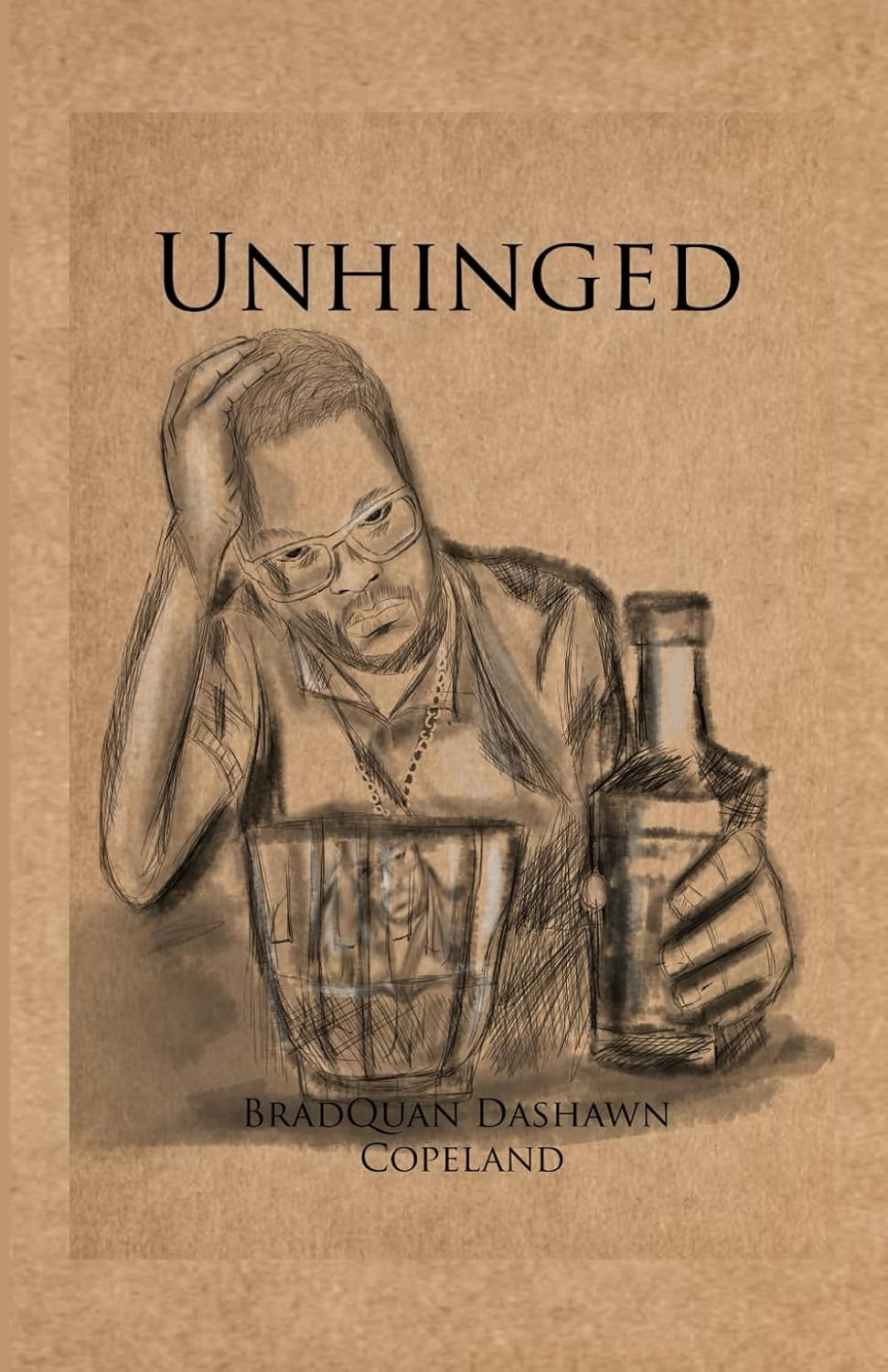
In December of 2023, I released my first chapbook, “Unhinged” — a soul-burning scream from the bellows of oblivion to let those in searing pain know they are not alone, and that the power of enlightened consciousness comes from facing truths most people won’t even dare to think of. Though it was extremely cathartic and helped me take back power from the madness that owned me, that didn’t mean the public was ready for it.
Through Submittable, I sent countless pieces to magazines and reviews, each met with silence. That was fine; the work was rooted in a raw, confessional tone beyond the standard. My issue came from the very community I was writing for. Upon emailing the manuscript to various local businesses to see if it was a suitable product worth carrying, I was met with awe and praise. I delivered several copies to multiple businesses, all of which sold out relatively quickly. Good reviews on Amazon and Goodreads gave me a strong sense of worth, but that worth quickly dwindled when I saw the in-person reactions of family members, acquaintances, and employees at the very locations where my book had sold out.
Stares of harsh judgment followed by awkward silence stung my spirit as I felt I’d failed in my mission. The positivity came from those I didn’t see, while the negativity came from those I did. I began to question myself as I sank into pity. Am I a bad writer? Am I a bad person? Was I crazy to think it made sense to put myself out there like this in the first place? I withdrew. I didn’t write. I couldn’t. I was trapped within a perpetual cycle of doubting the merit of my existence. Dramatic? You could say that. But art — real art — is born from such a deeply personal and vulnerable space that it carries a major aspect of your identity, almost like a child. I felt as if people were viewing me as someone still battling those demons, rather than someone who had fought to move past them.
Hell, I spent time crafting an intimate letter to readers before the material to set the stage, but it didn’t seem to matter. F*^k them. F*^k them all, I said, as I allowed my pierced ego to snatch the wheel, looking outward instead of inward — the very opposite of what led me here in the first place. I embarked on this path to speak to people like me because I believed, and still believe, that those who can change the world are the ones willing to say what most fear to face. I rejected the rejection that bound me, that binds so many, only to fall back into its deluding, wing-snapping hold.
Real art exists to hold up a mirror to the public. Throughout my misadventures, I’ve found that we often reject those who harbor the very qualities we resent about ourselves — not because we’re above them, but because we haven’t yet found the strength to honor them. I know that sounds insane, but the flaws we carry, no matter how ugly, are part of who we are. They don’t define us, but they shape who we become. By honoring the despicable, we accept ourselves as humans with the understanding that no matter the strength of our message, or how grand we may become, we’ll never speak to everyone — and that’s just fine.
The only thing that matters is that we continue to speak to ourselves, with the knowledge of the great James Baldwin: “Not everything that is faced can be changed, but nothing can be changed until it is faced.” Even when an extension of ourselves is rejected, it doesn’t diminish the magnitude of our message. It simply provides an alternate path to acceptance. Nothing that stings is meant to hinder those who can live outside the box. Through that knowledge, I not only write again, but I remind myself that, despite any shortcomings, when I leave this earth, I will be remembered as one of the greatest writers of my generation. That’s the power of rejection.